
Recognizing Patterns to Lead Through Change
ISSUE 4
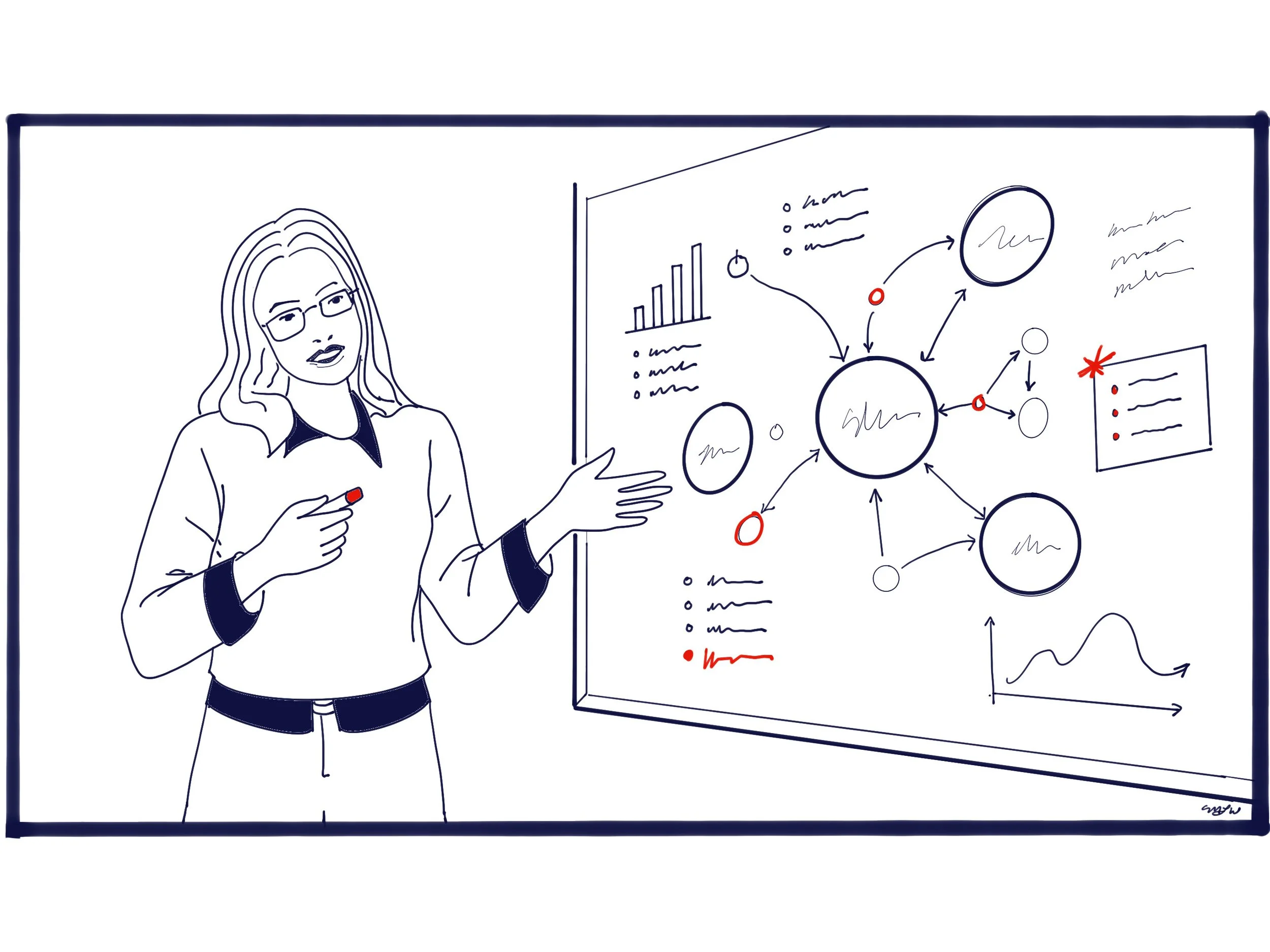
Person presenting at whiteboard, showing patterns.
A friend once told me that I explain things through interpretive dance.
She was right.
I think in pictures, images, and metaphors. I process information visually. Whiteboards, journals, drawings, and the images I build in my mind help me connect dots.
When I describe something complex, my hands get involved. I point toward imaginary corners. I draw shapes in the air. I give ideas a physical shape and invite other people to picture them with me.
Over time, I have come to appreciate what this way of thinking gives me.
I see connections. I notice when the same issue appears in several places under different names. I pull together information from separate conversations that suddenly seems relevant to the decision in front of us.
I recognize patterns.
That has become one of the most useful skills in my work as a change leader.
During periods of change, leaders rarely receive information in a clean sequence. We hear fragments, concerns, data points, questions, and observations from different parts of the organizations. One of our responsibilities is recognizing when separate issues may be connected, while resisting the urge to decide too quickly what the connection means.
The information comes in pieces
A manager mentions that a position has been difficult to fill.
A finance report shows rising overtime.
Someone in another meeting talks about delayed referrals.
A staff member quietly explains that people are covering responsibilities that used to belong to another role.
Any one of those concerns deserves attention. When they begin to cluster, they may reveal something larger about workload, role clarity, staffing, or the design of the work.
Organizations are remarkably good at compensating for unresolved problems. People build workarounds. Managers absorb responsibilities. Teams create informal processes to keep things moving.
Over time, those adaptations can begin to look like normal operations.
The information does not arrive in an orderly fashion. We have to notice what keeps showing up.
That requires steadiness.
Leaders are surrounded by information, much of it carrying urgency. We have dashboards, emails, meeting notes, staff concerns, board questions, community feedback, and service data. We remain responsible for deciding which signals deserve attention, whose knowledge is missing, and what context changes their meaning.
Sometimes the most useful move it to resist explaining the problem too quickly and stay with the information a little longer.
The first pattern is a hypothesis
Experience helps leaders recognize familiar dynamics quickly. It also gives us familiar explanations, and those explanations can arrive before we have heard enough.
I have learned to treat the first pattern I see as a hypothesis.
It gives me a place to ask better questions:
I have heard this concern in three different meetings. Where else is it showing up?
This problem seems to occur at the same point in the process. What happens there?
Several people are asking for clarification about the same decision. What information are they receiving?
I am beginning to connect these events. What are you seeing from where you sit?
Which part of this picture may be incomplete?
The answers matter because people hold different pieces of the organization.
A senior leader may see the budget, strategic commitments, and relationships across departments. A program director knows what happens when a process meets the reality of the workday. A frontline employee can identify the exact point where a handoff fails. A community partner may see an effect the organization has not yet recognized.
No single vantage point provides the whole picture.
People need to be able to examine the picture
A pattern held in my mind has limited value to the group. I have to find language for it.
I might say:
“I have heard the same question about approval authority from three program directors this month. Each request has moved through a different path, and all three were delayed. I wonder whether people are working from different understandings of who can make the decision.”
Now other people have something they can respond to.
They can confirm the connection, challenge it, or add the history and context that I am missing. The conversation may strengthen the pattern or substantially change it. Both outcomes are useful because the group has a clearer picture than any one person had before.
Pattern recognition becomes a leadership practice when other people can test the connection, add what they know, and help determine whether there is enough information to guide action.
Steadiness helps us stay curious
Leadership steadiness includes staying present with incomplete information, strong feelings, and pressure to act while continuing to listen and think.
It may look like pausing before offering an explanation.
It may mean asking one more person what they have observed.
It may require saying,
“Here is the pattern I think I see, and here is what I still need to understand.”
That kind of transparency helps a team participate in the thinking. It also gives people permission to bring forward information that changes the picture.
Once the pattern is clear enough, the group can decide what comes next. They might clarify authority, adjust a workflow, look more closely at staffing, test a change, or bring a larger question to the team or board.
Then we keep noticing.
Curiosity helps us watch what happens, consider new information, and continue testing the response.
Did the change affect the pattern?
Did it resolve one problem and reveal another?
Are people experiencing the process differently?
Has new information altered our understanding?
Pattern recognition helps us connect what has happened with what is happening now as we consider what may come next. The picture becomes more useful when we continue updating it.
What keeps showing up?
A few questions I find useful:
❔ What question keeps surfacing in different forms?
❔ Where does this process repeatedly stall?
❔ Which teams are independently solving versions of the same problem?
❔ What topic consistently changes the energy in the room?
❔ What are people compensating for that we have started treating as normal?
Steady leaders make time to notice repetition. They listen across roles. They put words around what they see. They invite others to test the picture. Then they help the group make a thoughtful decision with the information available.
Pattern recognition does not require certainty. It requires enough steadiness to notice repetition, enough curiosity to question our first explanation, and enough humility to invite other people into the picture.
At your next leadership meeting, consider posing this question:
What challenge have we seen more than once, and who else may hold a piece of the picture?
Give the visual thinkers in the room enough time, a whiteboard, and working markers.
Some of us have learned to bring our own.
Dried-out conference-room markers are not a pattern we need to keep repeating.
If your organization is navigating recurring challenges, significant change, or a leadership transition, I welcome a conversation. Connect with me through WileyExec.com.
Drawing of whiteboard markers - blue, green, and red