
The Appropriation of Trauma: When Corporate Jargon Hollows Out Clinical Care
By Michelle Wiley, MA, LPC

The behavioral health field has spent decades building a rigorous, evidence-based framework around what trauma is, how it presents, and what it actually takes to address it. Watching that framework get borrowed and rebranded by corporate consultants is, to put it plainly, a problem.
A recent article published by McKinsey & Company, "How Leaders Can Help Their Organizations Metabolize Strain," [1] provides an unfortunately good example of this trend. The authors attempt to map clinical trauma terminology onto standard corporate management challenges. The result is a collection of loose connections that takes a well-researched healthcare framework and reduces it to something nearly meaningless.
“When consulting firms appropriate clinical language without clinical rigor, they dilute the very concepts they are trying to leverage.”
One flaw in the McKinsey piece is its fundamental misunderstanding of trauma. The authors move fluidly between "stress," "strain," "fear of loss," "anxiety," and "trauma" as if these terms are interchangeable. Clinically, they are distinct phenomena.
Trauma is defined by the Substance Abuse and Mental Health Services Administration (SAMHSA) as an event, series of events, or set of circumstances experienced by an individual as physically or emotionally harmful or life-threatening, with lasting adverse effects on functioning and well-being [2] . Stress and strain are normal, adaptive physiological and psychological responses to challenge. Trauma involves a rupture in the nervous system's capacity to process experience.
The article illustrates its premise with a vignette about executives arguing in a boardroom over a capital allocation decision. The authors describe this using trauma-informed language, noting that "the participants' nervous systems began scanning for threat." Executives disagreeing about an acquisition is normal organizational conflict. Labeling routine workplace tension as a trauma response trivializes the experiences of individuals who have survived actual abuse, threats, violence, or profound neglect.
The authors attempt to justify this slippage by redefining trauma itself: "Traumatic experiences are often thought of as rare, but if we include developmental experiences that felt harmful, frightening, or overwhelming, many people have adapted to some form of trauma." This is an extraordinarily broad redefinition. If every frightening developmental experience constitutes trauma, then everyone is a trauma survivor, and the term loses clinical utility.
To bolster its claims, the article relies heavily on a McKinsey Health Institute survey of 30,000 employees, noting that 33 percent report experiencing a traumatic event that has affected their lives. The authors immediately concede that this data is "not causal," yet they build their entire organizational framework on the implication of causality. The methodology is highly questionable. The survey relies on self-reporting rather than clinical validation. It conflates a history of trauma with active trauma symptomatology. The article extrapolates from this correlational data to recommend sweeping organizational design changes.
The article repeatedly uses the word "metabolize" as a stand-in for processing emotions, and the title leans on it heavily. It functions as a catchphrase - one that carries both a pop-culture wellness feel and a therapeutic undertone. Somatic practitioners do sometimes use "metabolize" as a metaphor in psychotherapy, and that usage has earned its place through genuine clinical work with the body's responses to trauma. When a consulting firm borrows the same word to describe executives arguing over a capital allocation, it diminishes the work that term represents. This is part of a broader pattern of lifting clinical language out of context and deploying it for corporate credibility.
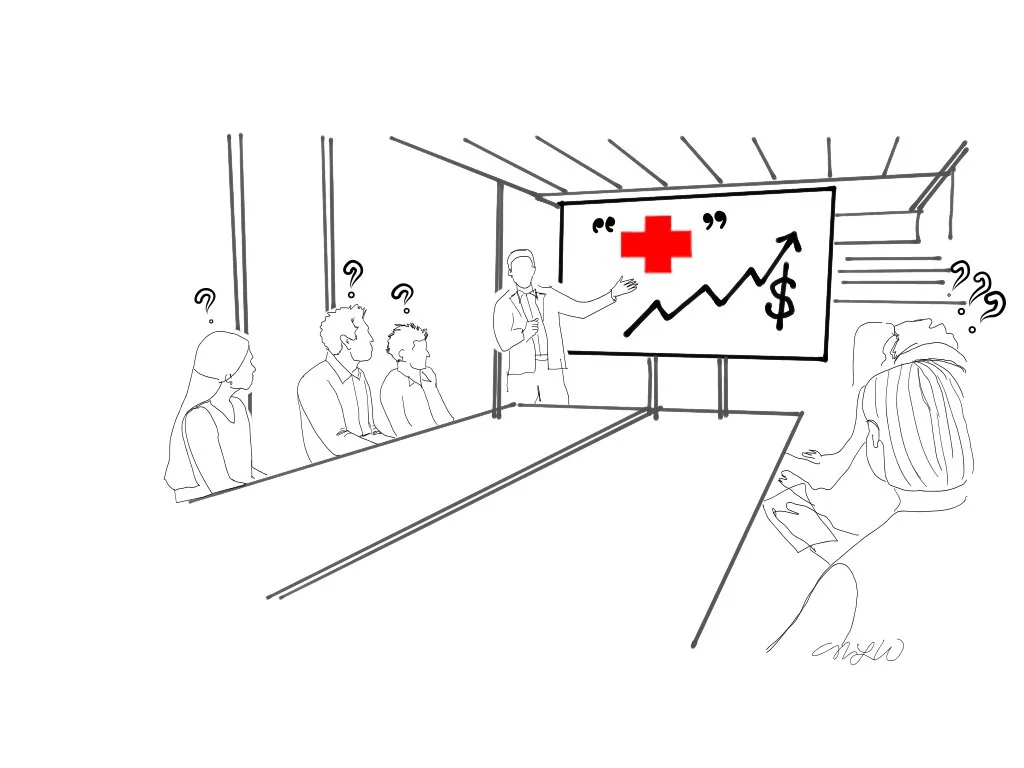
Similarly, the interventions the authors propose as "trauma-informed" are standard management practices repackaged with therapeutic language. The primary example offered is a "funeral meeting" held during a restructuring to help a team process the end of projects and shifting resources. This is a structured team retrospective. Agile retrospectives and after-action reviews have a long history in organizational development and have nothing to do with trauma-informed care.
The authors also propose an "I-I / I-You / I-We" framework (self, relationships, system), a standard leadership development model (individual, interpersonal, organizational) dressed up in new terminology. Their practical recommendations of identifying triggers, pausing to breathe, and asking open questions are basic mindfulness and coaching techniques.
A genuinely trauma-informed workplace requires specific, rigorous practices such as trauma screening and referral pathways, policies and practices designed to prevent re-traumatization, specialized training for staff and managers, and specific accommodations for survivors. The McKinsey framework offers none of this. It borrows the prestige of the SAMHSA framework (which it cites in a footnote) without engaging any of SAMHSA's actual core principles, such as peer support, empowerment, or cultural and historical context.
The engagement on the LinkedIn post mirrors the epistemological emptiness of the article itself (all too common these days with the abundance of AI-generated content). A review of the 55 comments reveals an echo chamber of performative profundity. The comments fall into predictable patterns such as engagement-bait platitudes ("Pressure makes diamonds"), restatements of the article's thesis, and generic affirmations from company pages.
Notably absent from the discussion is a single comment from a behavioral health professional, trauma therapist, social worker, or clinician. The substantive pushback came from a few individuals questioning the methodology or pointing out that poor organizational choices are often the root cause of workplace strain. The most highly engaged comment correctly identified that the real leadership challenge is preventing the organization from generating unnecessary strain in the first place, and made its point without ever using the word "trauma."
When consulting firms appropriate clinical terminology to describe routine business challenges, they do a disservice to both fields. They offer executives the illusion of psychological depth while failing to provide the rigorous structural changes required for actual trauma-informed care. They also dilute the language needed by clinicians and survivors to describe profound psychological injury.
Organizations need leaders who are emotionally intelligent, who communicate clearly, and who design coherent systems. Calling that trauma-informed care does not make it more true. The behavioral health field built that framework to protect and serve people who have been profoundly harmed. It deserves better than a rebrand.
References
[1] McKinsey & Company. "How leaders can help their organizations metabolize strain." McKinsey Quarterly. Authors J. Lavoie and R. Srinivasan with M. Lyons and Y. Rabhan. April 21, 2026.
[2] Substance Abuse and Mental Health Services Administration (SAMHSA). "SAMHSA's Concept of Trauma and Guidance for a Trauma-Informed Approach." HHS Publication No. (SMA) 14-4884. Rockville, MD: Substance Abuse and Mental Health Services Administration, 2014.